Driverless Cars and
The Chauffeur Problem
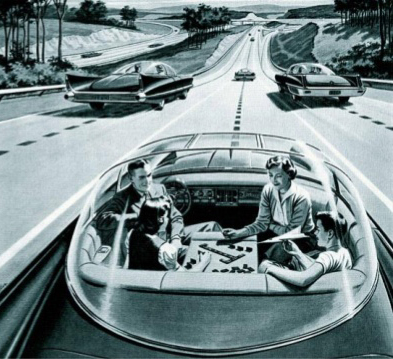

The article was sourced from a review of historian Kevin Borg’s book ‘The Chauffeur Problem’ by Car & Driver contributing writer Malcolm Gladwell.
A driverless shuttle bus being tested in Las Vegas was involved in a crash an hour into it’s first day on the job – although, technically, it wasn’t the bus’ fault. The eight-seater vehicle, started as a pilot of Las Vegas’ “Smart City” infrastructure, was struck by a delivery vehicle reversing. The Hop-On’s computer program causes it to stop when a collision is close, which means it also failed to avoid it.
While driverless vehicles are seen as safer than humans, at least in fair conditions, they have also been seen as over-cautious and can move in a robotic fashion, meaning human drivers may also fail to anticipate their movements, causing a crash.
This point in auto history is compared to “The ‘Chauffeur Problem” of a century ago in recent articles by Kevin Borg and Car & Driver columnist Malcolm Gladwell. They point out that the first automobiles in the early 1900’s were a pain to operate. Worse, they needed constant adjustment and repair. The substandard lubricants of the day required weekly oil changes. Responsibility for the maintenance and repair of the new technology of the automobile was outsourced to the Chauffeur. The Coachman—the man responsible for keeping horses fed and shod and carriages clean and functional in the horse and carriage days —was transformed into the Chauffeur. Wealthy motorists wanted to enjoy the exhilaration of speed and the freedom of long-distance travel without rails, which automobiles offered; an instrument of convenience, without the burden of operating and maintaining it. The automobile trip was also considered a social setting to its first owners, like the carriage before it.
As the guardians of the new technology, chauffeurs grew increasingly more arrogant, taking kickbacks from garages, hiring out their owners’ cars after hours, and showing general insubordination. After all, you didn’t know how to operate or fix the thing, right? Alarmed owners were forced to crack down. The idea of having a Drivers’ License actually originated from this “problem” by 1912.
Meanwhile, cars themselves grew steadily more reliable, making the chauffeur less and less necessary. And, as the automobile matured, owners ultimately realized that what they wanted from the new technology was not convenience at all. They wanted control. They discovered that the act of driving was the kind of freedom pleasure best kept for themselves. And of course, after the postwar boom, driving was a national pastime. The car changed our world forever.
The autonomous-vehicle revolution is beginning, and we are now in a very confusing stage. Who came up with these terms anyway? A human piloting a car is autonomous. The driver slows and speeds up or turns and stops entirely as he or she chooses. Autonomy was the point of getting rid of the chauffeurs. This new class of electronically-directed vehicles is the opposite of autonomous: It is a return to the idea that we are better off leaving the task of driving to a third party. The phrase “self-driving car” is worse. The self-driving car does the opposite of drive itself. It is a vehicle embedded in a technological grid, with a system of sensors and algorithms. “Autonomous” and “self-driving” mislead because they promise a kind of self-sufficiency on the part of the machine.
But the coming class of cars does not take care of itself at all. These cars are dependent on a network. Once a car belongs to a network, you have to worry about whether the network is safe. Once an algorithm is in command, you have to worry about how the algorithm thinks. We are surrendering control as surely as the first car owners of a century ago did, and when you surrender control, you could end up with a chauffeur problem.
The chauffeur problem reminds us that in any period of technological transition, most of the time it’s not the technology itself, it’s working out the details, rules, and social expectations around the technology. Look how the cell phone in the car are creating problems not forseen: laws are changing to keep your eyes on the road, not on the phone. Traffic accidents aren’t the worst of it- how about the behavioral problems of thousands of kids buried in their phones, unable to relate to the real world? The creators of the Smartphone did not see the impact on the social enviroment. Their agenda was to liberate and enlighten, but for some it’s becoming psychosis; a drug.
It wasn’t Audi, Ford, or GM that pushed hardest for the dependent -vehicle. It was Apple, Google, and Intel, companies for which the automobile is not primarily an aesthetic object and driving is not an instrument of pleasure. The users they have in mind are the brain-dead kids lying passively on the couch with their Smartphones.
Some defenders of the technology will admit it’s not quite ready for consumers yet, like airline travel back in the 1930’s, very dangerous. Anyone want to guess how the insurance claims will be handled?
If the car is in charge, I guess the ‘passenger’ is not at fault.
A nightmare lawyers are drooling over.
Politicians practicing Science will only lead to disaster. Billions are being spent by car companies and computer giants to convince us all that we need and want self-driving cars. Has anyone asked the people who drive? Isn’t this just another scheme to take our individual liberties away? If a device can drive your car, who can control the device? Big Brother can decide when, how fast, how often, or whether you drive or not!
The future is here. Again.
Remember the HAL9000 computer in the movie 2001: A Space Odyssey?